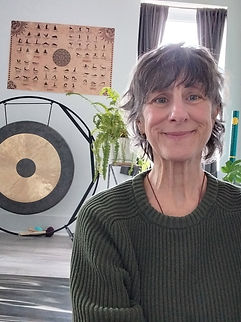
Jessie Jewell
Yoga Teacher, Jyotish Practitioner & Spiritual Counselor
My spiritual life began in childhood. I grew up in a religious family, and although I no longer follow the religion of my parents, their orientation gave me an early basis for wondering about the big questions: Who am I? Why am I here? What is going on?
At twenty-four, I found myself in a desperate situation and was exceptionally fortunate to find the 12-step program Overeaters Anonymous. The program teaches that recovery from addiction requires both a spiritual awakening and a spiritual way of life. In those early days of recovery, I decided spiritual practice would be my life’s priority, even though I had very little idea what that meant.
Not long afterward, I became involved in Re-evaluation Counseling. Here I learned that mental patterns can generate strong emotions, cloud clear thinking, and lead to choices that create more suffering. I also learned that these patterns can begin to loosen when a person is listened to deeply and without judgment. This continues to shape how I relate to people and understand the work I do with them.
I began practicing yoga in 1999 at High Desert Yoga in Albuquerque, New Mexico, where I found my teacher, Kim Schwartz. Kim taught asana with precision and humor. After class one day, when I was probably asking why I was struggling with a pose, he more or less waved away my physical question and told me that yoga was a mystical practice.
I did not even know what mystical meant, but I knew I wanted it. I decided then to commit myself to yoga.
Twelve-step recovery, Re-evaluation Counseling, and yoga have each taught me that we carry patterns of thought and behavior that cause suffering—and that through self-awareness, steady effort, and time, we can become more generous, joyful, and free.
I have spent the thirty-eight years since entering recovery finding out what it means to prioritize spiritual life. This has not been a tidy or saintly process. I have wrestled with compulsions, strong emotions, and relationships. Sometimes my spiritual life has looked mighty unenlightened. Yet I keep trying.
Most of what I know about spiritual practice has been worked out in ordinary life: through a partnership of more than thirty years, raising two children, earning a living, caring for a home and animals, and navigating everyday relationships. These circumstances keep revealing where I still have work to do.
Spiritual practice, as I understand it now, involves sincere self-examination, daily practice, and a willingness to stay the course. More and more, I understand the work as noticing where I cannot meet another person, myself, or what is happening with love—and working to become a clearer channel for kindness to flow through.

